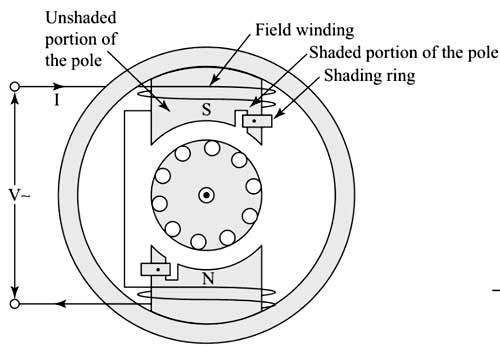
The shaded-pole motor is the original type of AC single-phase induction motor. Shaded pole-type single-phase induction motors are provided with shading rings on their poles which are the projected type of poles. The stator of such motors has projected poles like DC machines as shown in Fig. 5.7. The rotor is a squirrel cage type similar to that of split-phase-type motors. The poles are excited by giving a single-phase AC supply. A single-turn thick coil in the form of a ring called the shading ring is fitted on each side of every pole as shown. The portion of the poles where the shading ring is fitted is called the shaded portion, while the other portion is called the unshaded portion. The shaded pole motor has the lowest starting torque as compared to the all single-phase induction motors.
From the figure it can be concluded that the voltmeter reads 5 volts as shown in the figure below.
Based on the voltmeter and ammeter readings in the measuring network, determine the value of the resistor R
Here
Current I = 1/2 A = 0.5 A
Voltage V = 5 V
R = V/I = 0.5/5
R = 10Ω
During the positive half cycle of the supply, diodes D1 and D2 conduct are forward biased and conduct current while diodes D3 and D4 are reverse biased and they act as an open circuit, the current flows through the load.
The luminous efficiency of an electric lamp is the ratio of the luminous flux (in lumen) emitted by the lamp to the electric power (watt) given to it i.e. Luminous efficiency η = Luminous flux/Watt Note:- Lumens is the unit of measurement for luminous flux, which is the total amount of visible light emitted by a source. 1
Constantin‘, also known as ‘Eureka wire‘, is the trade-name for a copper-nickel alloy (approx. 60:40 ratio) formulated in the late 1800s by Edward Weston.