MGVCL Exam Paper (30-07-2021 Shift 2)
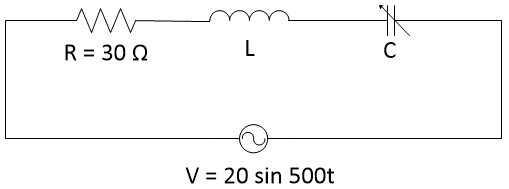
In the RLC series circuit shown in figure, resonance occurs when the value of C is 20 µF. The supply voltages is v(t) = 20 sin (500t) V. Find the value of L.
Here, ω = 500 rad/sec = 2πf. At Resonance condition, ωL = 1/(ωC) L 0.2 H Also at series resonace 1. fr = 1/[2π√(LC)] 2. PF = 1 3. Maximum current 4. Source voltage = voltage across resistor.
Simple logic of reactance diagram is that simplified equivalent circuit of power system in which the various components of power system are represented by their reactances. The reactance diagram can be obtained from impedance diagram if all the resistive components are neglected.
The neutral point of a generator is usually earthed to facilitate protection of the stator winding and associated system. Earthing also prevents damaging transient overvoltages in the event of an arcing earth fault or ferro resonance. For HV generators, impedance is usually inserted in the stator earthing connection to limit the magnitude of earth fault current.
When different types of consumers are charged at different uniform per unit rates, it is said to be Flat Rate Tariff. In this type, the consumers are grouped into different classes. Each class is charged at different uniform rate.
Frequency response analysis is the technique whereby a sinusoidal test signal is used to measure points on the frequency response of a transfer function or impedance function. Sweep Frequency Response Analysis (SFRA) testing provides insight into the mechanical and electrical integrity of transformers.
Main Purpose of SFRA Test: Transformer Core displacement Winding displacement for both rotor and transformer Broken or loosen clamp connections Inter turn short circuit Internal short circuit Winding to Core Earth fault Winding Open circuit condition