In terms of slip, the actual speed of the motor (N) can be expressed as N = Ns(1 − s) At start, the motor is at rest and hence its speed N is zero. s = 1 ( start) This is the maximum value of slip s possible for the induction motor which occurs at start. While s = 0 gives us N = N. which is not possible for an induction motor. So slip of the induction motor cannot be zero under any circumstances. Practically motor operates in the slip range of 0.01 to 0.05 i.e. 1 % to 5 %. The slip corresponding to the full load speed of the motor is called full load slip.
While estimating the overhead lines, the first and last pole is always earth connected and after every 3rd electrical pole, the fourth pole is earthed. Therefore, the approximate number of required ground set = 4
When the field winding is connected in series with the armature winding while supplying the load then the generator is called a series generator. Current Relations As all armature, field, and load are in series they carry the same current. IL = Ise = Ia
The size of the conduit is 62 meters. In conduit, there is a 2-phase wire and 1 neutral wire. Therefore the total number of conducting wire is 3 in a conduit Total length of cable = 62 × 3 = 186 meters.
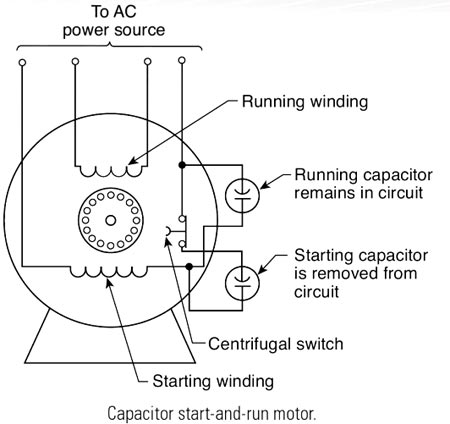
This type of motor is designed to operate with the start winding and it’s series capacitor permanently connected to the supply. lt has two capacitors connected in parallel in the start winding circuit for starting purposes. The running capacitor is employed to correct the power factor. As a result, this motor has a higher starting torque as well as a higher efficiency. These motors are employed in sizes ranging from 375 W to 7.5 kW. The power factor of these motor is upto 80% to 100%.
 EXAMIANS