The transformers which are particularly designed to provide electrical isolation between primary and secondary circuits, without a change in voltage and current level are called isolation transformers. The turns ratio of such isolation transformers is 1:1 i.e N1 and N2. Hence, isolation transformers are also called 1:1 transformers. The isolation transformer greatly reduces any voltage spikes that originate on the supply side before they are transferred to the load side. Some isolation transformers are built with a turns ratio of 1:1. A transformer of this type has the same input and output voltages and is used for the purpose of isolation only. The main function of the isolation transformer is to reduce the voltage spike before it reaches the load.
The emitter current (IE) of a transistor has two components such as base current (IB) and collector current (IC). The base current (IB) is about 2% of the emitter current (IE), but the collector current (Ia) is about 98% of the emitter current (IE). ∴ IE > IC > IB IE = IB + IC
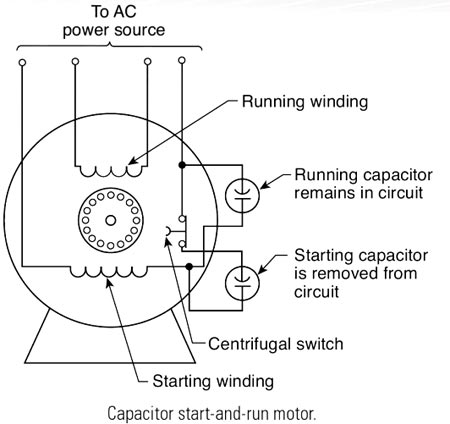
This type of motor is designed to operate with the start winding and it’s series capacitor permanently connected to the supply. lt has two capacitors connected in parallel in the start winding circuit for starting purposes. The running capacitor is employed to correct the power factor. As a result, this motor has a higher starting torque as well as a higher efficiency. These motors are employed in sizes ranging from 375 W to 7.5 kW. The power factor of these motor is upto 80% to 100%.
The wattage rating for a ceiling fan motor is in the range of 50 to 150 W. if the ceiling Fans size ranges from 36 inches to 56 inches then the total wattage use is 55 to 100 watts.. A 48-inch ceiling fan will use 75 watts.
Phosphorus (P) has 15 electron i.e 2,8,5. Hence the number of electron in its outermost orbit is 5. Silicon (Si) has 14 electron i.e 2,8,4. Hence the number of electrons in its outermost orbit is 4.