The total number of the conductor in stranded cable is given by N = 3x2 − 3x + 1 Where x = no. of layer For layer 1 N1 = 3(1)2 − 3(1) + 1 N1 = 1 For layer 2 N2 = 3(2)2 − 3(2) + 1 N2 = 7 In layer 2 no. of conductor = N2 − N1 = 7 − 1 = 6 For layer 3 N3 = 3(3)2 − 3(3) + 1 N3 = 19 In layer 3 no. of conductor = N3 − N2 = 19 − 7 = 12
Magnetic Field Strength (H) gives the quantitative measure of strongness or weakness of the magnetic field. H = B/μo Where B = Magnetic Flux Density μo = Vacuum Permeability Magnetic field due to infinite Linear current-carrying conductor is B = μoI/2πr B/μo = I/2πr H = (I/2πr)A/m
Mutual inductance between two coupled coils is given by the relation M = K√L1L2 Where L1L2 = Inductance of the coil K = Coefficient of coupling When K = 1 coils are said to be tightly coupled and if K is a fraction the coils are said to be loosely coupled. Here Kmax =1 Kmin =0 ∴ m ≤ (L1 L2 )0.5
During the positive half cycle of the supply, diodes D1 and D2 conduct are forward biased and conduct current while diodes D3 and D4 are reverse biased and they act as an open circuit, the current flows through the load.
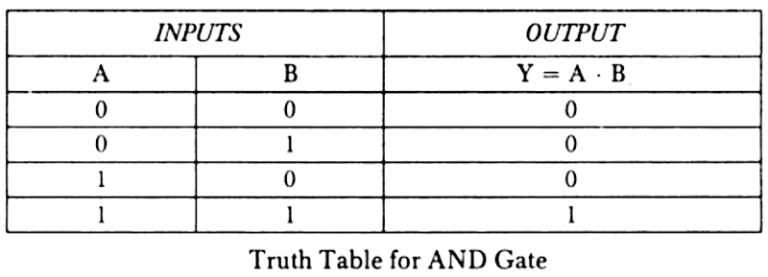
The circuit shown in the question is an AND GATE. In an AND gate has two or more inputs but it has only one output. An input signal applied to a gate has only two stable states, either 1 (HIGH) or 0 (LOW). In AND gate for any input A&B the output is A.B.