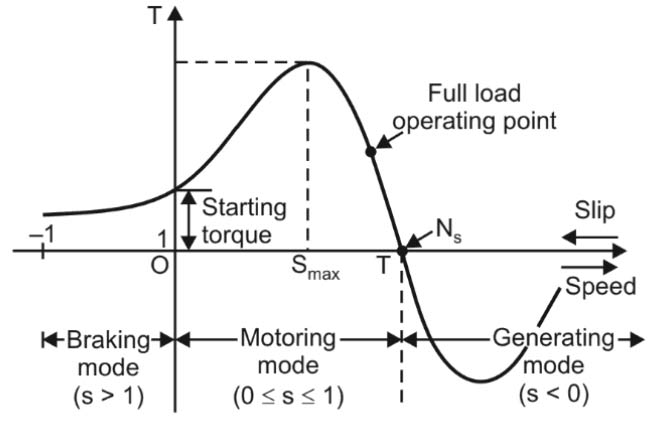
Torque speed characteristic of induction motor
Motoring mode: 0 ≤ s ≤ 1
For this range of slip, the load resistance in the circuit is positive, i.e. torque developed is in the direction in which the rotor rotates.
In this region the value of slip lies between 0 to 11 i.e., slip is positive.
The motor rotates in the same direction as that of a rotating magnetic field.
At s = 0 (synchronous speed), the torque produced by the motor is zero because the induced voltage in the rotor is zero when N= Ns.
The torque increases as the slip increases while the air gap flux remains constant.
The torque-slip characteristic from no-load to somewhat beyond full-load is almost linear.
Generating mode: s <0
In this operating mode, the slip s is negative i.e., s < 0. The slip will be negative if and only if the rotor speed N is greater than the synchronous speed Ns (N> Ns). However, the rotor and R.M.F both rotate in the same direction.
In this region, the motor acts as a generator and return the power back to a.c. source.
Braking or plugging Mode: s > 1
In this region, the value of slip is greater than 1 and the rotor rotates in the opposite direction of the rotating magnetic field.
This is achieved by interchanging any two phases of the stator supply.
 EXAMIANS
