Magnetic Fringing
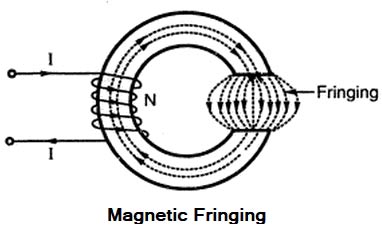
When flux enters into the air gap, it passes through the air gap in terms of parallel flux lines. There exists a force of repulsion between the magnetic lines of force which are parallel and having the same direction. Due to this repulsive force, there is the tendency of the magnetic flux to (spread out) at the edge of the air gap. This tendency of flux to spread out at the edges of the air gap is called magnetic fringing.
Magnetic fringing increases the effective cross-sectional area of the air gap reduces the flux density. So leakage, fringing, and reluctance should be as small as possible. This is possible by choosing a good magnetic material and making the air Magnetic fringing gap as narrow as possible.
 EXAMIANS