Control Systems Type and order of transfer function G (s) = K / {s(s + 2)} 0, 2. 1, 1. 2, 1. 1, 2. 0, 2. 1, 1. 2, 1. 1, 2. ANSWER DOWNLOAD EXAMIANS APP
Control Systems The transfer function of a phase lead compensator is given by: G(s) = (1 + 3Ts)/(1 + Ts) where T>0. What is the maximum phase shift provided by such a compensator? 60° 90° 30° 45° 60° 90° 30° 45° ANSWER DOWNLOAD EXAMIANS APP
Control Systems Force balancing equation of a dash-pot element is (where, x = displacement) B *x B dx/dt None of these B d2x/dt2 B *x B dx/dt None of these B d2x/dt2 ANSWER DOWNLOAD EXAMIANS APP
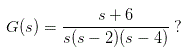
Control Systems Find the order of a system given by 5. 3. 4. 2. 5. 3. 4. 2. ANSWER DOWNLOAD EXAMIANS APP
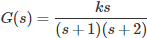
Control Systems The open loop transfer function of non unity negative feedback system is , then the number of root locus branches equal to 0. 3. 2. 1. 0. 3. 2. 1. ANSWER DOWNLOAD EXAMIANS APP
Control Systems Which of the following represents the value of resonant frequency (ωr)? 2*(ωn) √(1-ζ²) (ωn) √(1-2ζ²) (ωn) √(1-ζ²) (ωn) √(1-ζ²/2) 2*(ωn) √(1-ζ²) (ωn) √(1-2ζ²) (ωn) √(1-ζ²) (ωn) √(1-ζ²/2) ANSWER DOWNLOAD EXAMIANS APP
 EXAMIANS