Electric Circuits Three capacitors each of capacity C are given. The resultant capacity (2/3) C can obtained by using them two in parallel and third in series with this combination. two in series and third in parallel across this combination. all in series. all in parallel. two in parallel and third in series with this combination. two in series and third in parallel across this combination. all in series. all in parallel. ANSWER DOWNLOAD EXAMIANS APP
Electric Circuits In RLC series circuit R = 2Ω, L = 2mH and C = 1μF. Find the time constant of the circuit? 4 msec 1 μsec 2 μsec 2 msec 4 msec 1 μsec 2 μsec 2 msec ANSWER DOWNLOAD EXAMIANS APP
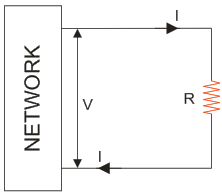
Electric Circuits For the network shown below when I = 0, V = 20 V and when R = 0, I = 10 A. If now R = 3 Ω what is the value of the current I? 10 A. 4 A. 5 A. 6 A. 10 A. 4 A. 5 A. 6 A. ANSWER DOWNLOAD EXAMIANS APP
Electric Circuits The energy required to charge a 10 μF capacitor to 100 V is 0.01 J. 10 × 10-9 J. 0.05 J. 5 × 10⁻⁹ J. 0.01 J. 10 × 10-9 J. 0.05 J. 5 × 10⁻⁹ J. ANSWER DOWNLOAD EXAMIANS APP
Electric Circuits Three resistances of two ohms each are connected in star. In the equivalent delta representation each resistance will have a value of _______________ Ω. 0.6. 3.4. 5.2. 6. 0.6. 3.4. 5.2. 6. ANSWER DOWNLOAD EXAMIANS APP
Electric Circuits The maximum value of a current wave is 2A. If the form factor of a current wave is 1.5 and the peak factor is 2.7, find the rms value in Amperes. 1.414 A. 0.741 A. 0.494 A. 1.57 A. 1.414 A. 0.741 A. 0.494 A. 1.57 A. ANSWER DOWNLOAD EXAMIANS APP
 EXAMIANS