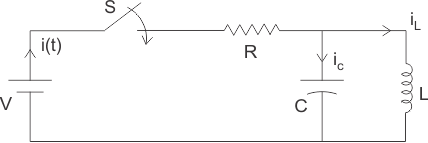
Electric Circuits Consider the following circuit : Switch is closed at t = 0 Find i(0 +) 0. (V*L) / (R*C) V / {R + (sL + 1 / Cs)}. V/R. 0. (V*L) / (R*C) V / {R + (sL + 1 / Cs)}. V/R. ANSWER DOWNLOAD EXAMIANS APP
Electric Circuits If C be the capacitance, V be the potential difference and I be the current, then I / CV will have the unit of power. reactive power. time. frequency. power. reactive power. time. frequency. ANSWER DOWNLOAD EXAMIANS APP
Electric Circuits A 50 μF capacitor is charged to retain 10 MJ of energy by a constant charging current of 1 A. Determine the voltages across the capacitor? 60 V. 30 V. 20 V. 50 V. 60 V. 30 V. 20 V. 50 V. ANSWER DOWNLOAD EXAMIANS APP
Electric Circuits The resistance of 200 W, 200 V lamp is 100 Ω. 800 Ω. 200 Ω. 400 Ω. 100 Ω. 800 Ω. 200 Ω. 400 Ω. ANSWER DOWNLOAD EXAMIANS APP
Electric Circuits What is represented by the hypotenuse of impedance triangle? Apparent power. Impedance drop. Resistance drop. Reactance drop. Apparent power. Impedance drop. Resistance drop. Reactance drop. ANSWER DOWNLOAD EXAMIANS APP
Electric Circuits Open circuit voltage of a fully charged lead acid cell is 2 V. 2.5 V. 1.9 V. 2.7 V. 2 V. 2.5 V. 1.9 V. 2.7 V. ANSWER DOWNLOAD EXAMIANS APP
 EXAMIANS